Payroll understanding: Everything you need to know, explained simply
Here you can learn what a payslip is, how it is structured, how to calculate payroll, and what you should keep in mind regarding record-keeping and legal requirements.
cleverlohn combines payroll services and an HR platform in one place. You enter changes digitally, and we take care of professional processing. Includes a dedicated contact person, streamlined workflows, and digital payroll documents for your team.

"The cleverlohn team was able to tell us exactly where information was still missing and what we needed to add. The team was truly great — the support from our personal contacts was especially valuable."
Linda Strauch
People Culture Manager, spized
What is a Payslip?
The payslip is the monthly statement that an employer must provide to every employee. It shows how the net income paid out is derived from the agreed gross salary, which deductions have been made, and which contributions are being paid by the employer and employee to social security institutions and the tax office.
Under Section 108 of the Industrial Code (GewO), employers are required to provide employees with a clear and complete payslip in text form.
Remuneration, wage, or salary – what is the difference?
These terms are often used interchangeably in everyday life. Strictly speaking, the following applies:
- Wage is paid for work based on time or performance (e.g., hourly wages in the trades).
- Salary refers to a fixed monthly income, regardless of hours worked.
- Remuneration is the umbrella term for any form of remuneration from an employment relationship.
In practice, the term "payslip" (Entgeltabrechnung) is now standard, even if terms like "wage statement" (Lohnabrechnung) or "salary statement" (Gehaltsabrechnung) are still used internally. They all refer to the same document.
Structure of a payslip:
What must be included?
Payslips must follow a legally defined structure. Missing mandatory information can lead to fines and, in case of doubt, entitles the employee to claim back payments.
The following information is mandatory:
Employer and employee details
- Company name and address
- Employee's name, address, and date of birth
- Social security number, tax ID, and tax class
- Religious affiliation (relevant for church tax)
- Start date and, if applicable, end date
Billing period and remuneration amount
- Payroll month and payroll year
- Gross pay (base wage, hourly wage, or salary)
- Allowances, surcharges, and special payments (listed individually)
Deductions and contributions
- Income tax, solidarity surcharge, and church tax (if applicable)
- Employee's share of statutory health, long-term care, pension, and unemployment insurance
- If applicable, contributions to company pension schemes or capital-forming benefits
Employer contributions (for information purposes)
- Employer's share of social security contributions
- If applicable, contributions to levies (U1, U2, insolvency levy)
Net pay and payout amount
- Net amount after all deductions
- Actual amount paid out (may vary, e.g., due to advances or offsets)
Since the 2025 ruling by the Federal Labour Court (BAG), employers are also required to transparently state the hours worked on the payslip, unless other documentation has been agreed upon. To be on the safe side, it is best to link time tracking and payroll directly.

The key terms and abbreviations simply explained
Payslips are full of abbreviations and technical terms. Here are the most important ones you should know:
Gross pay
The agreed remuneration before any deductions. It serves as the basis for calculating taxes and social security contributions.
Net pay
The amount that remains and is paid out after all taxes and social security contributions have been deducted.
Tax class (I to VI)
Determines the amount of monthly income tax deduction. The tax class is stored in the electronic income tax deduction features (ELStAM) and is automatically retrieved by the employer.
Social security contributions
Social security contributions. These consist of contributions to statutory health insurance, long-term care insurance, pension insurance, and unemployment insurance. Employers and employees each pay approximately half.
Contribution assessment ceiling
Above a certain gross income, no further social security contributions are due. The contribution assessment ceiling is adjusted annually. For 2026, the following values apply: pension insurance (West) 8,050 euros/month, health and long-term care insurance 5,512.50 euros/month.
Employer levies (U1, U2)
Employers pay levies to finance continued remuneration in the event of illness (U1) and maternity (U2). Smaller companies benefit from reimbursements via the compensation procedure (AAG).
Income tax allowance
Individually registered amount that reduces taxable income, e.g., for commuting expenses or degree of disability.
Marginal employment (Minijob)
For employees with a monthly income of up to 556 euros (2026). Special flat-rate levies apply to the employer; employees are largely exempt from contributions.
Midijob (transition zone)
Reduced employee social security contributions apply to employees with a monthly income between 556.01 and 2,000 euros.
Sunday, holiday, and night work surcharges
Tax-free surcharges for work on Sundays, public holidays, and at night, provided that legal requirements and maximum limits are met.
Calculating payroll: Step-by-step guide
Calculating a correct payslip always follows the same logic. Once you have understood the process, you will also be able to quickly spot errors on other people's payslips.
Step 1: Determine gross salary
The starting point is the agreed gross salary plus all variable components such as overtime premiums, bonuses, benefits in kind, or allowances. Tax-free supplements (e.g., for Sunday, holiday, or night work) are listed separately.
Step 2: Calculate social security contributions
The current contribution rates are applied to the gross salary subject to contributions (gross salary up to the respective contribution assessment ceiling). As a rule, employees and employers each pay half.
Example contribution rates for 2026 (employee share):
- Health insurance: approx. 8.05% (depending on the health insurance fund's additional contribution)
- Long-term care insurance: 1.7% (without children: 2.3%)
- Pension insurance: 9.3%
- Unemployment insurance: 1.3%
Step 3: Calculate income tax and solidarity surcharge
Income tax is determined based on the tax class and taxable gross income (gross pay minus tax-free portions). This is based on the current income tax tables provided by the Federal Ministry of Finance. Those subject to church tax pay an additional 8% to 9% on their income tax.
Step 4: Calculate net pay
All employee social security contributions, as well as income tax, the solidarity surcharge, and any applicable church tax, are deducted from the gross pay. The result is the net pay.
Step 5: Determine the payout amount
In most cases, the payout amount is equal to the net pay. Deviations may occur due to items such as salary advances, garnishments, or the offsetting of non-cash benefits.
Item | Amount |
|---|---|
Gross pay Health insurance employee share (8.05%) Long-term care insurance employee share (1.7%) Pension insurance employee share (9.3%) Unemployment insurance employee share (1.3%) Income tax (tax class I, approx.) Solidarity surcharge Net pay (approx.) | €3,500.00 €281.75 €59.50 €325.50 €45.50 €412.00 €0.00 approx. €2,375.75 |
Note: This is a simplified calculation example. The actual payout amount depends on the health insurance supplementary contribution, individual tax allowances, and other factors.
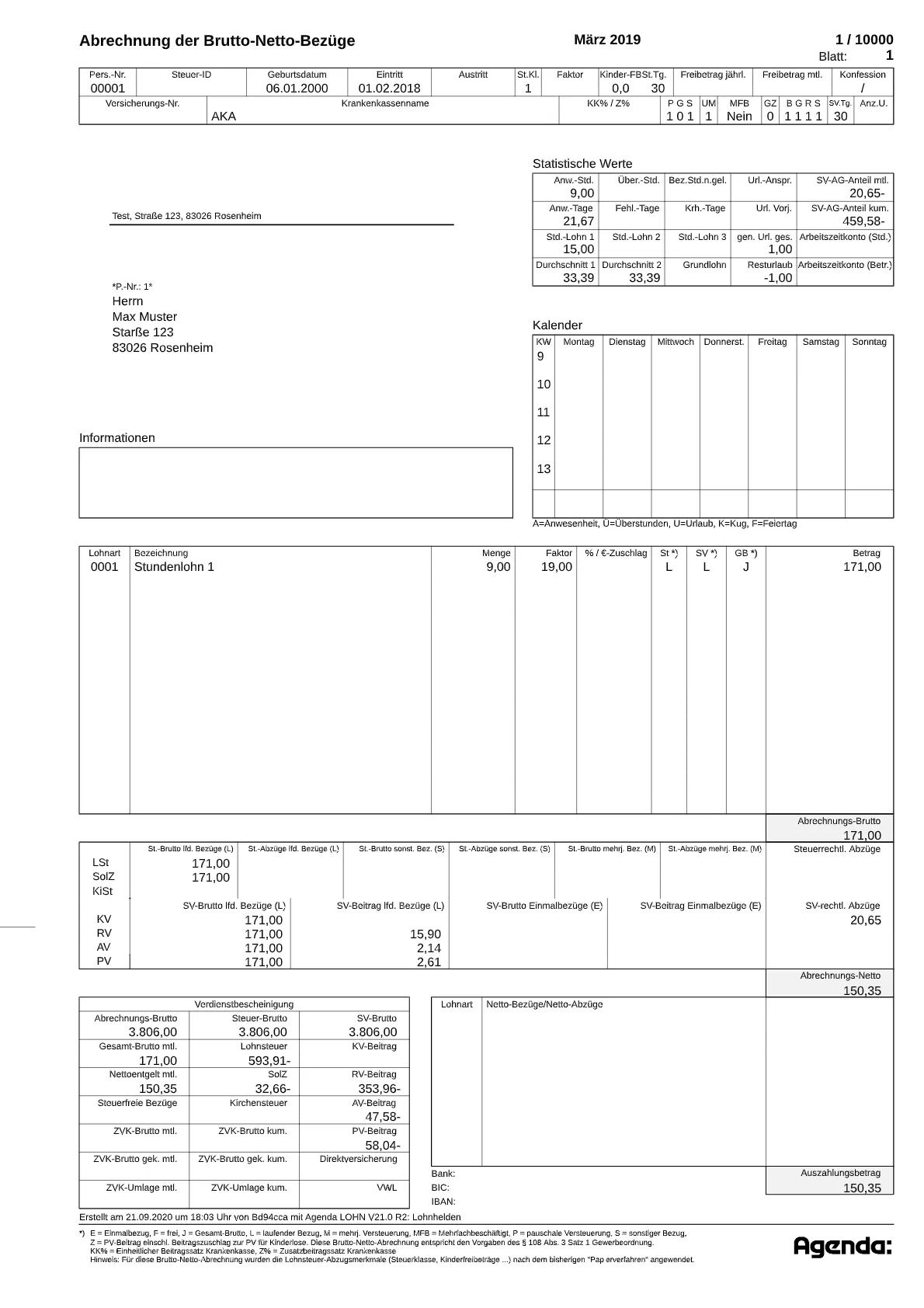
Payslip template: This is what a payslip looks like
A good payslip template helps you understand the structure immediately. Instead of just explaining terms, you can see at a glance where gross components, deductions, and net pay are located.
A good template shows:
- Employer and employee details
- Payroll period
- Gross components
- Statutory deductions
- Net pay
- Notes and additional information
For employees, founders, and small businesses in particular, a template is the easiest way to get started.
How long Payroll statements keep?
Several retention obligations apply to payroll statements simultaneously. The most important are:
6 years: Retention obligation according to GoBD
Payroll statements are tax-relevant accounting vouchers. According to the principles of proper accounting (GoBD), they must be kept for at least 6 years.
10 years: For documents relevant to wage tax
Payroll accounts and associated supporting documents must be kept for 10 years in accordance with Section 41 of the German Income Tax Act (EStG).
Indefinite: Pension insurance contribution records
Documents relevant to future pension calculations should be secured permanently, as employees may request proof decades later.
GDPR and digital archiving:
Anyone archiving payroll records digitally must comply with GDPR requirements. This applies in particular to access restrictions, deletion periods, and proof of data security. Audit-proof software is mandatory here.
2025 Federal Labour Court ruling:
With its ruling on working time recording, the Federal Labour Court has tightened the requirements for documenting hours worked. Employers who have not yet linked time tracking and payroll should do so as soon as possible.
Note: This section provides general guidance. For binding legal advice, please consult a tax advisor or an attorney specializing in labor law.
Why payroll is often unnecessarily complex is
In many companies, payroll is still handled via emails, Excel spreadsheets, and manual follow-ups. This wastes time and makes the process unnecessarily prone to errors.
Typical problems include incomplete master data, late changes, variable payments without a clear process, and a month-end closing that has to be improvised every single time.
When payroll is organized this way, it is often no longer just about individual payslips. The question then arises whether it makes more sense to outsource payroll accounting and set up the entire process more reliably.
What other companies saywith cleverlohn.

More than satisfied to have finally found a solution for payroll accounting. Response times are always within minutes, and they are ready with the right answers for a wide variety of cases and issues. Keep it up!

The cleverlohn concept was the deciding factor for us – young, dynamic, and digital. This approach won us over because we had always been looking for a clean, digital solution. We are happy with our decision to outsource this.

We have had a fantastic experience with cleverlohn for over six months now. Always punctual and accurate payslips, immediate assistance from the team whenever we have questions, and simple digital access to all our information allow us to spend more time on strategic HR matters.

We really value the work of cleverlohn and our personal payroll accountant, and we are so glad to finally have someone who truly knows what they are doing.

Our old payroll system was incredibly opaque and cost us a lot of time. With cleverlohn, we now save eight to ten times as much time and have significantly less administrative effort.


Why cleverlohn is the smart solution for payroll accounting is
Many companies face the same decision: handle payroll in-house, buy software, or hire a service provider. Here is a direct comparison.

✓ Real payroll accountants
✓ Dedicated contact person
✓ Monthly trial payroll
✓ HR platform included
✓ Automatic accounting integration
✓ Filings & certificates
From €13.00 per payslip
Payroll software
✓ Automatic accounting integration
✗ No personal contact person
✗ No trial payroll
✗ Filings only manual
Flat-rate subscription, full administrative burden
Tax consulting
✓ Real payroll accountants
✓ Filings & certificates
✗ No guaranteed dedicated contact person
✗ No HR platform
✗ No trial payroll
Usually higher costs per
payslip
What cleverlohn specifically handles:
Personal support
For individual questions, simply contact your personal payroll accountant directly via email, chat, or phone.
Payroll
online
Invite all employees to manage their own personal data and download their payslips.
100% transparency, at any time
Deadlines, confirmed monthly closings, processing statuses, and payroll details for employees in your calendar overview.
Flexible master data management
No two months are the same. Easily record all working hours, absences, and special payments online.
Timely reminders
To ensure payroll is processed on time, we send you reminders to approve all relevant data.
Integration of your tax advisor
We handle the integration of your tax advisor and create the interface for a seamless workflow.
Reliable payroll accounting with cleverlohn.
One price for everything.
Our all-inclusive price: As simple as cleverlohn
Always calculate with confidence. No base fees, no hidden costs.
cleverlohn
- Dedicated payroll specialist included
- All HR software features included
- Employee access included
- Base priceincl.
- Employee registration and deregistrationincl.
- Certificates, such as employment certificatesincl.
- Annual reportsincl.
- Communication flat feeincl.
Other providers
- Personal payroll accountant included
- All HR software functions included
- Employee access included
- Base price18 €
- Onboarding and offboarding of employees18 €
- Certificates, such as employment certificates15 €
- Annual declarations20 €
- Communication flat rate15 €
Keep an eye on costs with cleverlohn.
Frequently Asked Questions to the payroll statement
What is the difference between an Entgeltabrechnung and a Lohnabrechnung?
What is the difference between an Entgeltabrechnung and a Lohnabrechnung?
These terms refer to the same document. "Lohnabrechnung" (wage statement) and "Gehaltsabrechnung" (salary statement) are colloquial variations; "Entgeltabrechnung" is the legally correct term according to Section 108 of the Industrial Code (GewO), which covers all types of remuneration.
Who is required to create a payroll statement?
Who is required to create a payroll statement?
Every employer in Germany is legally required to provide their employees with an understandable payroll statement in text form or digitally with every wage payment. This also applies to mini-jobbers.
Does the payroll statement have to be provided in writing or on paper?
Does the payroll statement have to be provided in writing or on paper?
No. Since a change in the law, digital provision is sufficient as long as the employee can access it. Many companies now provide payroll statements via an employee portal.
What happens if the payroll is incorrect?
What happens if the payroll is incorrect?
Incorrect payroll can lead to back payments to employees, fines from social security agencies, and issues during tax audits. Common mistakes include incorrect tax classes, forgotten surcharges, and incorrect health insurance assignments.
Can I handle payroll myself?
Can I handle payroll myself?
Yes, that is possible, but it is demanding. Accurate calculation requires up-to-date knowledge of tax tables, social security contribution rates, tax-free allowances, and industry-specific requirements. Mistakes happen easily and can become expensive.
How long does onboarding take at cleverlohn?
How long does onboarding take at cleverlohn?
Once the contract begins, we collect all relevant master data and create a test payroll run before the first official one. Most companies are fully set up within one or two payroll cycles.
Why should I choose cleverlohn?
Why should I choose cleverlohn?
cleverlohn means: trained and experienced professionals, clear processes beyond just the web app, and a full team commitment to handling your payroll.
In3 simple stepsOutsource your payroll
We make getting started a breeze:
Transfer your data once, and everything runs automatically from then on. No downtime due to vacation or illness, because we are always here for you.
- Step 1: Transfer data.
We retrieve all your employees' master data from your previous payroll provider, or you can invite them to upload it themselves. Everything is done in minutes. - Step 2: Use the platform.
Enter hours, absences, and bonuses. Everything is checked automatically. - Step 3: Receive payroll.We create, verify, and deliver: Ready for payout via email, portal, or post.
Go to thePayroll app
The hub of your payroll accounting
Payroll handled? Talk to us now
We advise you personally, professionally, reliably, and cost-effectively.
Your team is ready.