
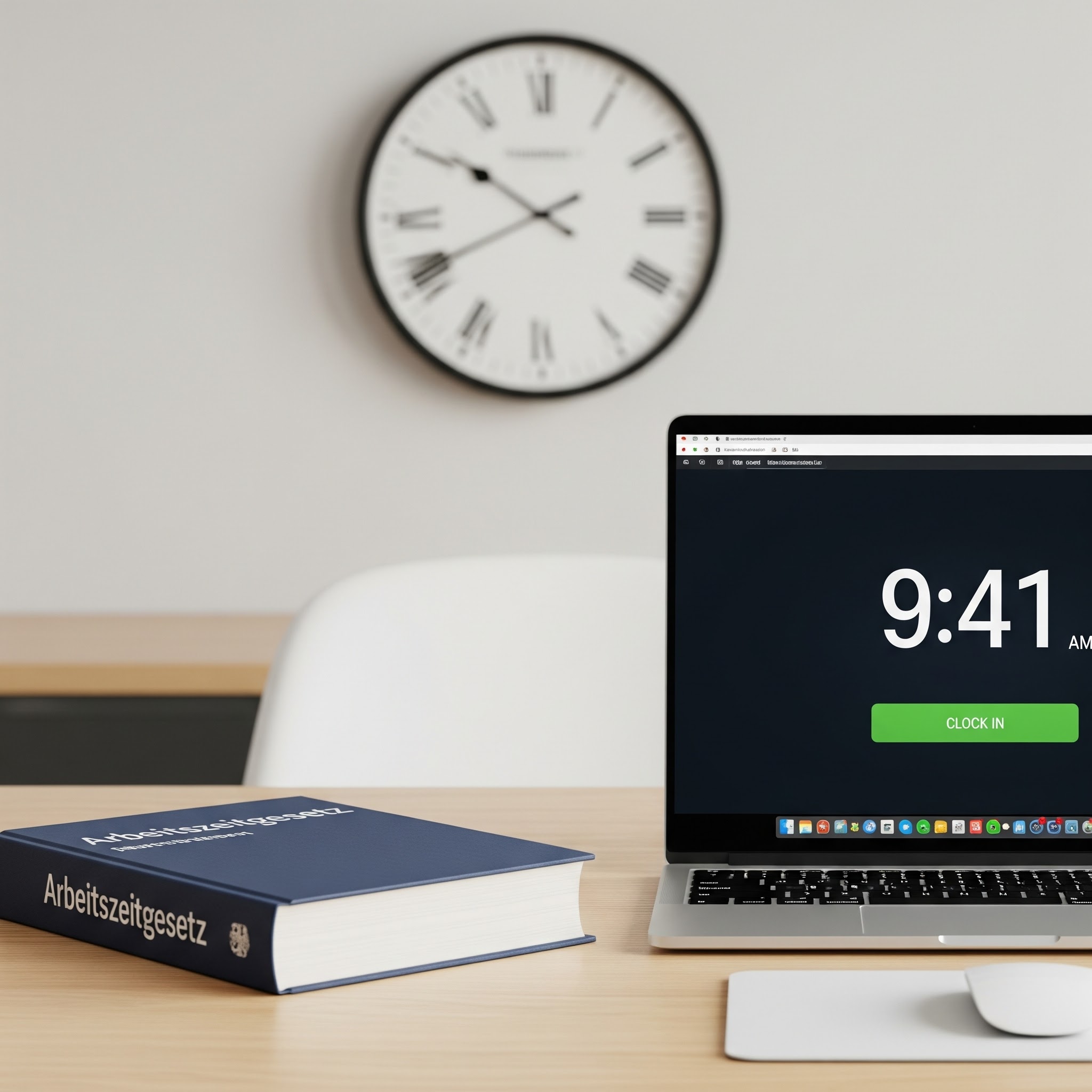
What does the Working Hours Act cover and why does it matter?
The Working Hours Act (Arbeitszeitgesetz, ArbZG) protects the health and safety of employees through clear rules on working hours and rest periods. At the same time, it confronts employers with complex challenges in practice, especially when it comes to correct records in online payroll.
The Working Hours Act pursues several core protective goals, all aimed at safeguarding the health and wellbeing of employees. The first is protection against overwork and the health damage that follows from it. Clear limits on daily and weekly working hours are meant to stop staff from being pushed beyond their physical and mental limits over long periods. The law also guarantees enough rest so that employees can fully recover between shifts. Another important aspect is the protection of rest on Sundays and public holidays. This respects religious and cultural traditions while also protecting shared periods of rest in society. Finally, the ArbZG helps people balance work and family life by creating predictable working hours with enough room for their private lives.
Complying with these rules takes organisational measures. It also takes precise time tracking and records, which modern payroll software systems can automate.
The key rules of the Working Hours Act in detail
Daily working hours and maximum working hours
The basic rule of the Working Hours Act is that regular daily working hours must not exceed 8 hours. This fundamental provision is the backbone of all other employment law rules and is not negotiable. However, the law has an important flexibility clause: under certain conditions, daily working hours can be extended to up to 10 hours. This extension has limits. It must be offset within 6 calendar months or 24 weeks so that the average does not exceed 8 hours a day. Written records of every extension are especially important, because they must be produced during inspections.
Professional digital payroll is an invaluable help here. It can run these complex calculations automatically and warn you early when limits are about to be exceeded. The weekly view follows a similar pattern: as a rule, no more than 48 hours a week may be worked. If daily working hours are extended to 10 hours, a maximum of 60 hours a week is possible. Here too, the extra hours must be offset over a period of 6 months.
Rest breaks and how to apply them correctly
The break rules of the Working Hours Act are precisely defined and leave little room for interpretation. For daily working hours of 6 to 9 hours, a break of at least 30 minutes must be given. If working hours exceed 9 hours, the minimum break rises to 45 minutes. These breaks can be split into blocks of at least 15 minutes, which allows flexibility in day-to-day operations. Another important rule is that nobody may work for more than 6 hours in a row without a break.
This creates particular challenges for online payroll, because breaks must be recorded correctly and deducted from working hours. Modern time tracking systems that connect seamlessly to the payroll software can handle this automatically. They can also make sure that the statutory minimum breaks are respected.
Rest periods between working days
One of the most fundamental provisions of the Working Hours Act is the 11-hour rule. It states that at least 11 consecutive hours must pass between the end of one working day and the start of the next working period. This rule protects employees from chronic fatigue. It ensures there is enough time for recovery, sleep and private activities.
Even so, the law allows exceptions for certain sectors. In hospitals and care facilities, the rest period can be reduced to 10 hours if this is needed to keep up patient care. Restaurants and hotels are subject to special rules that reflect the specific demands of the sector. In agriculture, seasonal adjustments are possible to match the natural cycles of farm production.
Monitoring these rest periods correctly is especially important in digital payroll. Breaches have legal consequences. They can also trigger supplements for shortened rest periods, which must be calculated and recorded properly.
Work on Sundays and public holidays: rules and exceptions
General ban on employment
As a rule, the Working Hours Act prohibits employing staff on Sundays and statutory public holidays. This rule respects religious and cultural traditions. It also supports social cohesion and shared rest. An absolute ban would not be practical in a modern society, though, so the law provides for important exceptions.
Several sectors have been granted exemptions because of their importance to society or the nature of their work:
- Hospitals and care facilities
- Restaurants and hotels
- Transport companies
- Media and telecommunications
- Security services
- Energy and water supply
These exceptions are no free pass. They require special compensation measures.
Compensation and supplements
Where work on Sundays and public holidays is permitted, strict compensation rules apply to make sure staff still get adequate rest despite the unusual hours. For Sunday work, a substitute rest day must be granted within two weeks. For public holiday work, a substitute rest day within eight weeks is enough. These different time frames reflect how much more often Sundays occur than public holidays.
In addition to substitute rest days, supplements often have to be paid, which the payroll software must calculate correctly. This means taking into account tax-free supplements under § 3b EStG, applying the right social security treatment and keeping correct records for any payroll audits.
Night work: special protective provisions
Night work is subject to special protective provisions because it can have a significant impact on the health and wellbeing of employees. The Working Hours Act defines night time as the period between 11 pm and 6 am. A special rule from 10 pm to 5 am applies to bakeries. Night workers are employees who either regularly work at least 2 hours of their daily working time at night or work at least 48 nights in a calendar year.
Stronger protective measures apply to this group of staff. Before night work begins, an occupational health check-up must take place. It must then be repeated at regular intervals. The interval depends on age: employees under 50 must have a check-up every three years. Those over 50 must have one every year. The limit on working hours is stricter for night work than for day work. On average, only 8 hours may be worked in any 24 hours. An extension to 10 hours, as allowed for day work, is not possible.
Digital payroll must be able to calculate night supplements correctly, taking into account both statutory minimum requirements and collective agreement rules. The tax and social security treatment of these supplements is also especially important.
How to handle on-call duty and standby correctly in payroll
In day-to-day operations there are several forms of readiness for work. Employment law treats them differently, so they place different demands on the payroll software. Active standby (Arbeitsbereitschaft) requires presence at the workplace. This time counts fully as working time and is paid normally. On-call duty (Bereitschaftsdienst) also requires presence at the workplace, with regular calls to work expected. It also counts fully as working time, although a flat-rate payment is often possible. Standby (Rufbereitschaft) differs in that the employee only needs to be reachable away from the workplace. Here only time actually spent working counts as working time. A flat standby allowance is paid for the time spent on standby.
Modern payroll software must be able to recognise these different forms of readiness automatically and handle them correctly in payroll. This includes automatically identifying each type of work, calculating supplements correctly and keeping complete records for any occupational safety inspections.
ArbZG compliance in practice
In real business life, applying the Working Hours Act quickly becomes complex. Different working time models, short-notice shift changes or missing break records can all lead to breaches. Manual recording is error-prone and time-consuming here.
Digital payroll solutions such as cleverlohn can help. They record working hours and breaks automatically, check rest periods, calculate supplements for night, Sunday or public holiday work and produce clear records for audits. This greatly reduces the risk of fines and gives everyone involved certainty.
Another advantage: time tracking, shift planning and payroll work together seamlessly. That means less admin, better planning and correct payslips at the push of a button.
cleverlohn: your partner for compliant time tracking
If you take the ArbZG seriously, you need a system that actively supports you as well as recording data. cleverlohn offers exactly that: a modern platform that checks working hours, spots breaches and automatically reminds you of required breaks or rest periods. Complex special rules (for example in hospitality or care) can also be mapped in a compliant way.
Our payroll experts make sure your payroll always meets legal requirements. This way you avoid legal risks. You also show responsibility towards your staff.
Conclusion
Applying the Working Hours Act correctly is a legal duty. It also brings real competitive advantages. Companies avoid expensive fines of up to €30,000 and costly legal disputes. At the same time, they benefit from higher employee satisfaction thanks to a better work-life balance. Well-rested staff are more productive, take fewer sick days and deliver better customer service.
Modern payroll software and digital payroll are essential tools for successful ArbZG compliance. They give you compliance certainty through automatic monitoring. They also create operational benefits through streamlined processes. An investment in professional online payroll usually pays for itself within the first year.
Start by analysing your current situation, invest in capable payroll software and train your teams on an ongoing basis. With the right strategy, ArbZG compliance turns from an obligation into a strategic advantage for your company.
This article is for general information only and does not replace individual legal advice. If you have specific questions about the Working Hours Act, you should consult a specialist employment lawyer.